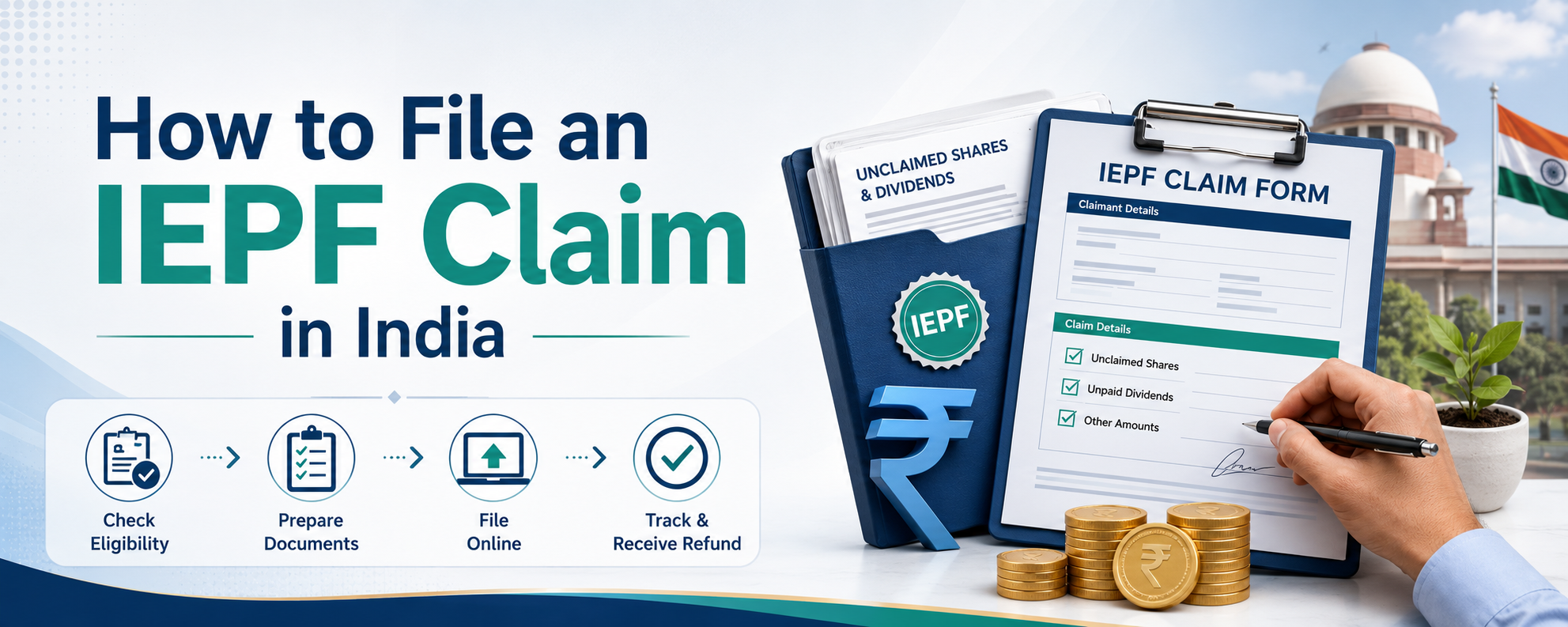
Many investors discover years later that their shares or dividends are no longer with the company. If dividends remain unpaid or unclaimed for a long period, the shares and related dividend amounts may be transferred to the Investor Education and Protection Fund, commonly known as IEPF.
The good news is that these assets are not permanently lost. A rightful shareholder, nominee or legal heir can file an IEPF claim and recover eligible shares and dividends by following the prescribed process.
IEPF Claim Guide
What Is an IEPF Claim?
An IEPF claim is the formal process through which an eligible claimant requests the return of shares, dividends, matured deposits or other investor amounts that have been transferred to the IEPF Authority.
The claim is generally initiated by filing Form IEPF-5. The claimant must then provide the required supporting documents to the concerned company for verification by its nodal officer.
Step-by-Step IEPF Claim Process
Check the Entitlement
Before filing a claim, verify whether the shares or dividends have actually been transferred to IEPF. This normally requires checking company records, folio numbers, shareholder details, dividend history and relevant IEPF information.
Prepare the Required Documents
The exact documentation depends on the nature of the claim, type of shareholding and whether the claimant is the original shareholder, nominee or legal heir.
- Aadhaar card or other accepted identity proof
- PAN card
- Cancelled cheque or bank account proof
- Client Master List or demat account statement
- Physical share certificates, where applicable
- Indemnity bond, where required
- Advance receipt or prescribed declaration
- Death certificate and legal-heir documents, where applicable
- Other supporting records requested by the concerned company
File Form IEPF-5
Form IEPF-5 must be submitted online with complete and accurate claimant, company, shareholding, bank and demat account details.
Mismatches in the folio number, PAN, identity details, bank information, demat account or shareholder name may delay the claim or result in deficiency remarks.
Submit the Supporting Documents
After filing Form IEPF-5, the claimant must submit the prescribed document set to the concerned company or its nodal officer according to the applicable procedure.
The company uses these records to verify the claimant's identity, ownership, bank details, demat account and entitlement.
Company Verification
The company reviews the documents and determines whether the claimant is entitled to receive the shares and dividend amounts.
After completing verification, the company submits its report to the IEPF Authority. Incomplete documents, inconsistent information or unresolved ownership issues may result in objections or additional document requests.
Approval and Credit
Once the claim is approved, eligible shares are credited to the claimant's demat account and the approved dividend amount is transferred to the registered bank account.
Why Do IEPF Claims Get Delayed?
IEPF claims may be delayed because of incorrect form filing, old signatures, mismatched addresses, incomplete KYC records, missing physical share certificates, succession disputes or incomplete legal-heir documentation.
| Common Issue | Why It Causes Delay |
|---|---|
| Death of the original shareholder | Additional succession, nomination or transmission records may be required. |
| Name or signature mismatch | The company may request identity or signature verification. |
| Old physical share certificates | Ownership and certificate details may require additional confirmation. |
| Joint shareholding issues | Multiple holders or legal representatives may need to provide records. |
| Outdated company records | The folio, address, bank or KYC information may not match current documents. |
Claim preparation tip: Review every name, folio number, bank detail, demat detail and supporting document before filing. Even a small inconsistency may result in clarification requests.
Frequently Asked Questions
Tap a question to expand the answer.
What is the Investor Education and Protection Fund (IEPF)?
The IEPF is a fund set up under the Ministry of Corporate Affairs to hold shares and dividend amounts that have gone unclaimed for the prescribed period. It exists so that rightful owners, nominees or legal heirs can later claim these assets back through a formal process.
How do I check if my shares or dividends have been transferred to IEPF?
Most listed companies publish a list of shareholders whose shares are due for, or have already been, transferred to IEPF, usually on their investor relations page or in the annual report. You can also check with the company's Registrar and Transfer Agent using your folio number or DP/client ID, or refer to the IEPF Authority's official records.
Is there a deadline for filing an IEPF claim?
Shares and dividends transferred to IEPF do not expire, and a claim can generally be filed at any time once the transfer has taken place. That said, filing sooner rather than later usually makes the process easier, since supporting records and signatures are simpler to match while they are still current.
How long does the IEPF claim process usually take?
Timelines vary depending on the company, the completeness of the documents submitted, and how quickly verification is completed at each stage. Claims with clean, matching records tend to move faster, while cases involving deceased shareholders, physical certificates or mismatched details can take considerably longer.
The original shareholder has passed away. Who can file the claim?
A nominee registered on the folio, or a legal heir, can generally file the claim on behalf of a deceased shareholder. This usually requires additional documents such as the death certificate, succession certificate, legal heir certificate, probate or letters of administration, depending on whether a nomination was in place.
Do I need the original physical share certificates to file a claim?
If the shares were held in physical form, the original certificates are usually required as part of the claim. If they have been lost or misplaced, most companies will accept the claim with additional supporting documents, such as an indemnity bond or affidavit, in place of the missing certificates.
Is there a fee for filing Form IEPF-5?
Filing Form IEPF-5 on the MCA/IEPF portal does not typically involve a government filing fee for the claimant. However, incidental costs may arise from notarization, affidavits, indemnity bonds or other supporting documents that the claim requires.
Can NRIs or claimants living abroad file an IEPF claim?
Yes, NRIs and other claimants residing outside India can file an IEPF claim, subject to providing the applicable identity, KYC and bank account documentation for their residency status. Coordinating notarization or attestation from abroad is often the main practical hurdle in these cases.
Need Help With an IEPF Claim?
Vitta Samadhan assists investors, nominees and legal heirs with IEPF claim recovery, Form IEPF-5 filing, document preparation, company coordination and claim follow-up.
Professional support can be particularly helpful in cases involving deceased shareholders, transmission of shares, physical certificates, old records, signature mismatches or complex legal-heir documentation.
Disclaimer: This article is intended for general informational purposes only. The claim process and document requirements may vary depending on the company, claimant category, type of shareholding and applicable rules. Verify the latest requirements with the concerned company, Registrar and Transfer Agent and official IEPF sources before filing a claim.