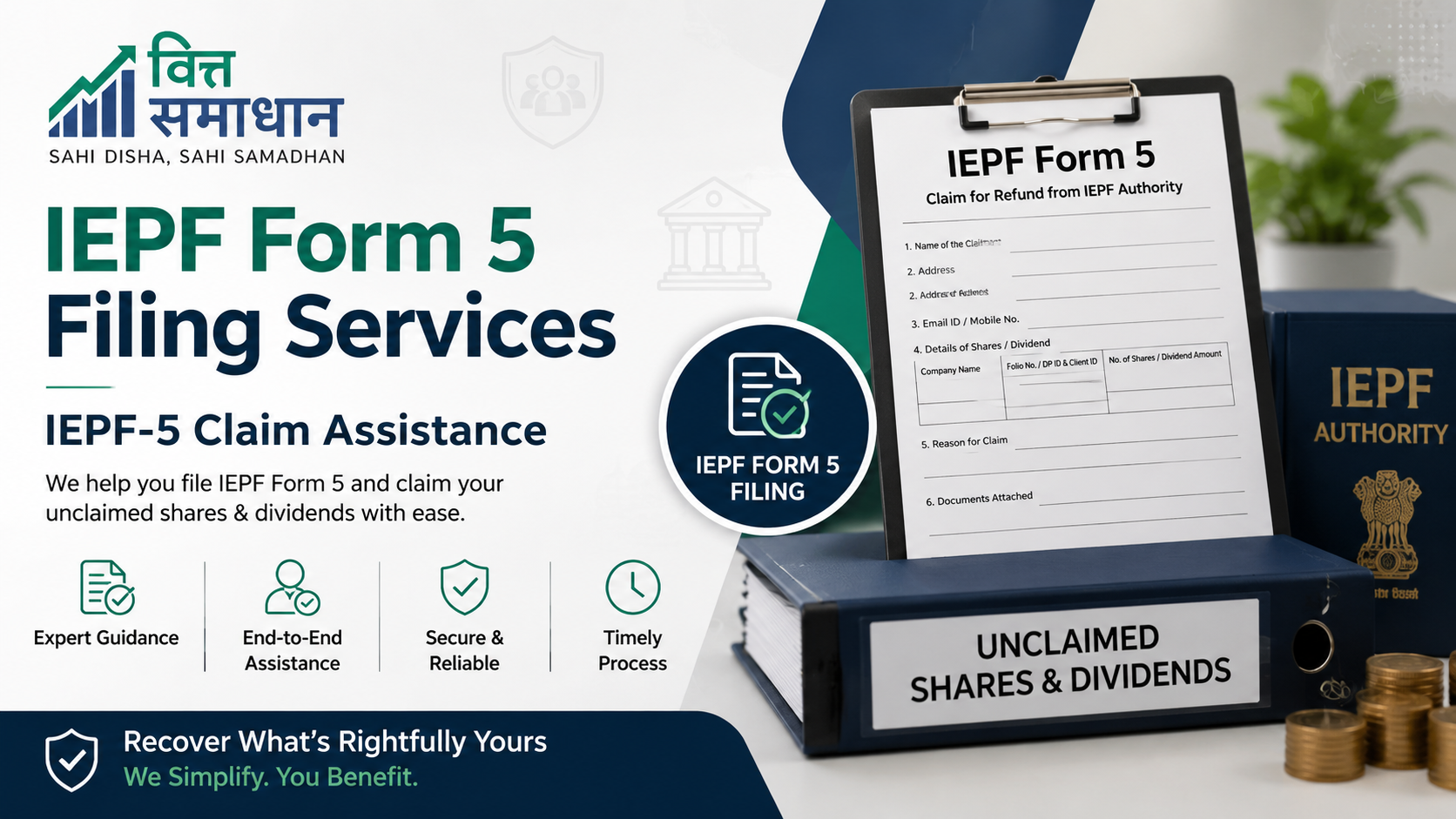
If your shares, unpaid dividends or other eligible investment amounts have been transferred to the Investor Education and Protection Fund Authority, you may be able to recover them by filing Form IEPF-5.
Filing the form is only one part of the recovery process. The claimant must also prepare the correct supporting documents, complete company verification and respond to any clarification raised by the company, Registrar and Transfer Agent or IEPF Authority.
IEPF Form 5 Filing Guide
What Is Form IEPF-5?
Form IEPF-5 is the prescribed application used by eligible claimants to request the refund of shares, unpaid dividends and certain other amounts transferred to the Investor Education and Protection Fund Authority.
Depending on the facts of the case, the form may be used to claim:
- Shares transferred to the IEPF Authority
- Unclaimed or unpaid dividends
- Matured deposits transferred to IEPF
- Matured debentures transferred to IEPF
- Application money due for refund
- Interest or other eligible investor amounts transferred to the Fund
Who Can File Form IEPF-5?
Form IEPF-5 may be filed by a person who is legally entitled to recover the shares or amount transferred to IEPF.
Eligible claimant categories
- The original shareholder or investor
- A registered joint holder
- A registered nominee
- A legal heir of a deceased shareholder
- A successor or legally entitled claimant
- An authorised representative, where legally permitted
Important: Nominee and legal-heir cases may require transmission of shares or additional succession documents before the IEPF claim can be processed.
Step-by-Step IEPF Form 5 Filing Process
Check Whether the Shares or Dividends Were Transferred to IEPF
Before filing the claim, verify whether the relevant shares, dividends or other amounts have actually been transferred to the IEPF Authority.
Check the concerned company’s website, unpaid dividend records, IEPF disclosures, folio details or information available from the company’s Registrar and Transfer Agent.
Confirm the Claimant’s Eligibility
Identify whether the claim will be filed by the original shareholder, nominee, joint holder, legal heir or another legally entitled person.
Claims involving a deceased shareholder, missing nomination, joint holdings or inheritance may require additional transmission and succession documents.
Open or Verify the Demat Account
An active demat account is generally required for the credit of recovered shares. The name and PAN in the demat account should match the claimant’s identity and claim records.
Obtain a recent Client Master List or Client Master Report showing the claimant’s name, PAN, DP ID and Client ID.
Resolve Name, PAN, Bank or Signature Mismatches
Compare the old shareholder records with the claimant’s current PAN, identity proof, bank account and demat account.
- Different spelling of the shareholder’s name
- Change of surname after marriage
- Initials used instead of the complete name
- Old or unavailable signature
- PAN not registered in the folio
- Different bank account details
- Old or mismatched address records
Prepare the Required Documents
Collect the documents required according to the claimant category, type of investment, physical or demat holding and the concerned company’s verification requirements.
- PAN card of the claimant
- Aadhaar card or accepted identity proof
- Cancelled cheque or bank account proof
- Client Master List for the demat account
- Original physical share certificates, where applicable
- Indemnity bond, where applicable
- Advance stamped receipt, where applicable
- Death certificate and transmission records, where applicable
- Other documents requested by the company or RTA
Fill Form IEPF-5 Carefully
Enter complete and accurate information in Form IEPF-5. The company name, folio number, claimant details, number of shares, dividend amount, bank information and demat details should match the supporting records.
Incorrect or incomplete information may result in clarification requests, deficiency remarks or rejection of the claim.
Submit Form IEPF-5 and Save the Acknowledgement
Submit the completed form through the prescribed online filing process.
Save the acknowledgement, Service Request Number and a copy of the submitted form. These details are required for tracking and future communication.
Submit Supporting Documents
Complete the supporting-document submission process according to the latest instructions and the requirements of the concerned company or its RTA.
Keep copies of all submitted documents and retain dispatch, delivery or electronic submission proof.
Company and RTA Verification
The concerned company and its Registrar and Transfer Agent verify the claimant’s identity, shareholding, entitlement, bank details, demat account and supporting documents.
The claimant may be asked to provide corrected documents, explanations or additional proof if any information is incomplete or inconsistent.
Verification Report and IEPF Authority Review
After completing its verification, the company submits the prescribed verification report or recommendation through the applicable system.
The IEPF Authority reviews the application and may approve the claim, request further clarification or take another action permitted under the applicable rules.
Approval and Credit of Shares or Dividend
Once an eligible claim is approved, the shares are generally credited to the claimant’s verified demat account and the approved monetary amount is transferred to the verified bank account.
Documents Required for IEPF Form 5
The exact document list depends on whether the claimant is the original shareholder, nominee or legal heir. The company or RTA may also request additional supporting records.
| Claimant Type | Commonly Required Documents |
|---|---|
| Original Shareholder | PAN, identity proof, cancelled cheque, Client Master List, share certificates where applicable, indemnity and claim acknowledgement. |
| Registered Nominee | Death certificate, nomination proof, nominee’s KYC, bank and demat details and transmission documents. |
| Legal Heir or Successor | Death certificate, legal-heir proof, succession certificate, probate, will, letters of administration or other applicable inheritance documents. |
| Physical Shareholder | Original physical share certificates, folio details, identity records, demat account proof and documents requested by the company or RTA. |
Document checklist: Do not rely on a general document list alone. Confirm the case-specific requirements with the concerned company or Registrar and Transfer Agent before submitting the claim.
Why Do IEPF-5 Claims Get Delayed?
IEPF claims may be delayed when the filed form does not match the records available with the company, RTA, bank, PAN database or Depository Participant.
| Common Issue | Why It Causes Delay |
|---|---|
| Incorrect folio or company details | The company may not be able to identify the correct holding or entitlement. |
| Name, PAN or signature mismatch | Additional identity, affidavit or signature-verification documents may be required. |
| Inactive or incorrect demat account | Approved shares cannot be credited until valid demat details are available. |
| Incomplete legal-heir documents | The claimant’s legal entitlement cannot be verified without complete succession records. |
| Missing physical certificates | A duplicate certificate or letter of confirmation process may need to be completed. |
| Incorrect share or dividend amount | The claim may not match the records transferred to the IEPF Authority. |
| No response to clarification | The claim cannot progress until the requested explanation or document is submitted. |
Filing tip: Review every name, folio number, PAN, bank detail, demat detail, share quantity and supporting document before submitting Form IEPF-5.
Frequently Asked Questions
Tap a question to expand the answer.
What is Form IEPF-5 used for?
Form IEPF-5 is used by an eligible claimant to request the refund of shares, unpaid dividends and other eligible amounts transferred to the Investor Education and Protection Fund Authority.
Can shares transferred to IEPF be recovered?
Yes. A rightful shareholder, nominee, legal heir or successor may apply for recovery by filing Form IEPF-5 and completing the prescribed document-verification process.
Is a demat account required for an IEPF share claim?
An active demat account is generally required because approved shares are credited in dematerialised form. The claimant’s name and PAN should match the claim records.
Can a nominee file Form IEPF-5?
A registered nominee may file the claim after meeting the company’s transmission and documentation requirements. A death certificate, nomination proof and nominee KYC records may be required.
Can a legal heir claim shares from IEPF?
Yes. A legally entitled heir or successor may file the claim. Additional documents such as a death certificate, legal-heir certificate, succession certificate, probate or other inheritance proof may be required.
What happens after Form IEPF-5 is submitted?
The supporting documents are submitted according to the prescribed procedure. The company or RTA verifies the claim and submits its verification report for review by the IEPF Authority.
How long does an IEPF-5 claim take?
The timeline varies according to document completeness, company verification, transmission requirements, mismatch resolution, clarification requests and review by the IEPF Authority.
What if the shareholder’s name does not match the PAN or demat account?
The mismatch may need to be corrected or supported with appropriate records. The company or RTA may request name-change proof, an affidavit, identity records or other supporting documents.
Can I file an IEPF claim without the original share certificate?
If the certificate has been lost, the claimant may need to complete the duplicate certificate or letter of confirmation process prescribed by the company and its RTA.
Can shares and unpaid dividends be claimed together?
Eligible shares and unpaid dividends transferred to IEPF may be included in the applicable claim. The claimant should enter accurate year-wise dividend and shareholding details.
Does filing Form IEPF-5 guarantee approval?
No. Approval depends on verification of the claimant’s identity, entitlement, company records, supporting documents and compliance with the applicable IEPF requirements.
Is there a government fee for filing Form IEPF-5?
The online form may not require a claimant filing fee, but costs may arise for affidavits, indemnity documents, notarisation, legal records, duplicate certificates or professional assistance.
Need Help Filing Form IEPF-5?
Vitta Samadhan assists shareholders, nominees and legal heirs with IEPF Form 5 filing, document preparation, share recovery, unpaid dividend claims, company coordination and claim follow-up.
Professional support can be particularly helpful in cases involving deceased shareholders, transmission of shares, legal-heir claims, physical share certificates, lost certificates, old records, signature mismatches or complex documentation.
Disclaimer: This article is intended for general informational purposes only. IEPF forms, procedures and document requirements may change. Requirements may also vary depending on the concerned company, Registrar and Transfer Agent, claimant category and facts of the case. Verify the latest requirements with the official IEPF sources and concerned company before filing.