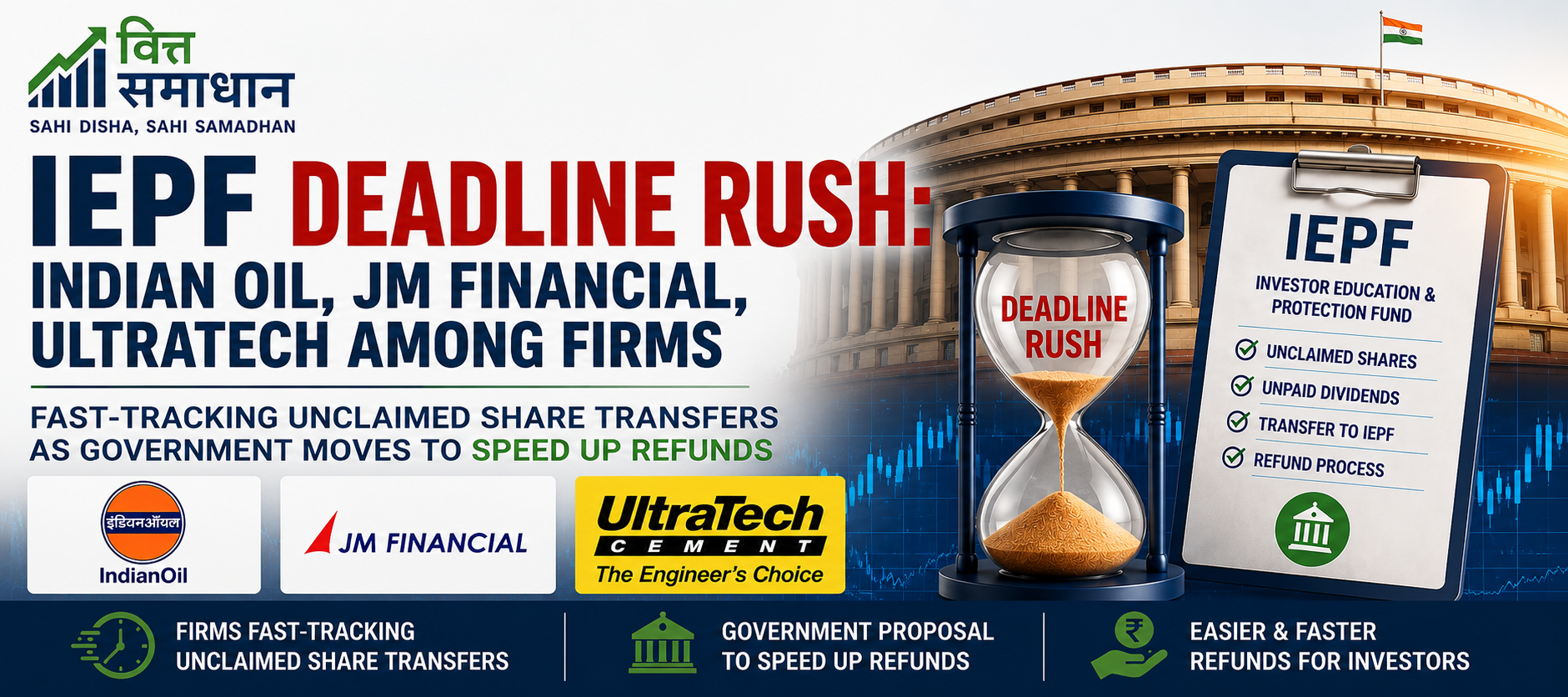
Indian Oil Corporation has asked eligible shareholders to claim unpaid or unclaimed dividends relating to its final dividend for financial year 2018–19.
Affected shareholders have been advised to complete the claim process by 31 July 2026 to avoid the transfer of eligible shares to the Investor Education and Protection Fund Authority, commonly known as the IEPFA.
Claim Deadline
31 July 2026
Proposed IEPF Transfer
2 September 2026
Relevant Dividend
FY 2018–19
According to information published by Indian Oil, the final dividend for FY 2018–19 is due to be transferred to the Investor Education and Protection Fund on 2 September 2026.
The company may also transfer eligible shares where the applicable dividends have remained unpaid or unclaimed for seven consecutive years, in accordance with the Companies Act and applicable IEPF rules.
The notice is especially relevant for investors holding old physical share certificates, shareholders whose registered bank or contact details are outdated, and legal heirs who may be unaware of investments held by deceased family members.
Key Points for Indian Oil Shareholders
- Claim unpaid FY 2018–19 final dividend by 31 July 2026.
- The dividend is due for transfer to IEPF on 2 September 2026.
- Eligible shares may also be transferred if related dividends remained unclaimed for seven consecutive years.
- Affected shareholders should contact Indian Oil or its Registrar and Share Transfer Agent.
- Shares and dividends transferred to IEPF may still be recovered through the prescribed refund process.
Why Shares and Dividends Are Transferred to IEPF
Under Section 124 of the Companies Act, 2013, unpaid or unclaimed dividend amounts that remain unclaimed for the prescribed period must be transferred to the Investor Education and Protection Fund.
Section 124(6), read with the Investor Education and Protection Fund Authority (Accounting, Audit, Transfer and Refund) Rules, 2016, also provides for the transfer of shares where the dividends associated with those shares have remained unpaid or unclaimed for seven consecutive years.
Important clarification: Missing one dividend does not automatically result in the transfer of shares. The share-transfer provision generally applies when the relevant dividends remain unclaimed throughout the required consecutive seven-year period.
Before transferring eligible shares, companies must follow the prescribed process, which generally includes notifying affected shareholders and publishing relevant information through appropriate channels.
Why Dividends Often Remain Unclaimed
- The shareholder changed address without updating company records.
- The registered bank account was closed or became inactive.
- PAN, bank details or KYC records were incomplete or outdated.
- Old physical share certificates were forgotten or misplaced.
- An old dividend warrant was not deposited or encashed.
- The shareholder passed away without informing legal heirs about the investment.
- Legal heirs were unaware that shares or dividends existed.
- Demat, identity or bank details did not match the company’s records.
Indian Oil’s 31 July 2026 Deadline
Indian Oil has stated that its final dividend for FY 2018–19 is due for transfer to the IEPF on 2 September 2026.
The company has asked affected shareholders to contact its Registrar and Share Transfer Agent, KFin Technologies Limited, and claim the unpaid dividend on or before 31 July 2026.
Indian Oil has also identified shares on which the applicable dividends have remained unclaimed for the required consecutive period. Relevant shareholder and share details have been made available through the company’s investor-information section.
Recommended action: Shareholders who have received an individual notice should act before the deadline and submit the documents requested by Indian Oil or its authorised Registrar and Share Transfer Agent.
What Happens After the Deadline?
If an eligible shareholder does not claim the unpaid dividend within the stated period, Indian Oil may transfer the dividend amount and corresponding eligible shares to IEPF in accordance with the applicable law and rules.
Physical Shareholding
The company may complete the transfer through the procedure prescribed under the IEPF rules. Existing physical certificates relating to transferred shares may no longer remain valid for dealing in those shares.
Dematerialised Shareholding
Shares held in demat form are transferred electronically through the depository system in accordance with the prescribed procedure.
Do Shareholders Permanently Lose Their Investments?
No. Shares and dividends transferred to IEPF are not permanently forfeited merely because the company’s claim deadline has passed.
The rightful shareholder, nominee or eligible legal heir may apply to recover transferred shares and unpaid dividends from the IEPF Authority through the prescribed refund process, generally involving Form IEPF-5.
Recovering assets after transfer usually requires more documentation and verification than claiming the unpaid dividend directly from the company before the deadline.
How the IEPF Refund Process Generally Works
Check the Transfer Status
Confirm whether the shares or unpaid dividend have actually been transferred to IEPF.
Review the Latest Instructions
Check the latest official procedure and requirements for filing Form IEPF-5.
Prepare the Documents
Collect the required identity, bank, demat, shareholding and entitlement records.
Submit the Application
File the claim through the prescribed Ministry of Corporate Affairs facility.
Complete Company Verification
Provide the required documents to the concerned company or its Registrar and Share Transfer Agent.
Respond to Clarifications
Complete any additional clarification or verification requested by the company or IEPF Authority.
Documents That May Be Required
The required documents depend on whether the claimant is the original shareholder, nominee, joint holder or legal heir.
- PAN and accepted identity documents
- Proof of address
- Cancelled cheque or bank-account proof
- Client Master List for the applicant’s demat account
- Original share certificates, where applicable
- Evidence of ownership or entitlement
- Death certificate of the original shareholder
- Nomination or transmission documents
- Succession certificate, probate or letter of administration, where applicable
- Legal-heir or family-settlement documents, where accepted or required
- Other declarations or supporting documents prescribed for the particular claim
Not every document is required in every case. Applicants should follow the latest official checklist applicable to their claimant category and shareholding type.
Proposed Simpler Processing for Low-Value IEPF Claims
Separately from company-specific transfer notices, the Investor Education and Protection Fund Authority has considered measures to simplify the recovery process for smaller investor claims.
Recommendations announced on 6 September 2025 proposed simplified documentation and verification for certain low-value claims.
| Claim Type | Proposed Value Limit |
|---|---|
| Physical securities | Up to ₹5 lakh |
| Dematerialised securities | Up to ₹15 lakh |
| Dividend claims | Up to ₹10,000 |
Important: These measures were described as recommendations. Investors should not assume that a fast-track timeline or simplified process is available unless the relevant amendment or official procedure has been formally notified and implemented.
What Indian Oil Shareholders Should Do Now
Check the Official Notice
Confirm the dividend, financial year, folio number and deadline mentioned in the company notice.
Verify the Source
Use the company’s official website, stock-exchange filing or communication from its authorised Registrar and Share Transfer Agent.
Contact Indian Oil or Its RTA
Submit the required dividend claim and supporting documents before the stated deadline.
Update KYC and Bank Details
Ensure PAN, address, bank account, email, mobile number and nomination details are correctly recorded.
Check Old Physical Holdings
Verify whether old folios have unpaid dividends, incomplete KYC records or shares liable for transfer.
File Form IEPF-5 After Transfer
Where shares or dividends have already been transferred, follow the latest IEPF refund procedure rather than submitting an ordinary unpaid-dividend request.
Legal Heirs Should Review Old Family Investments
Legal heirs should examine old financial records of deceased family members for share certificates, demat statements, dividend warrants, annual reports, bank statements and correspondence from companies.
Even where original certificates are unavailable, information such as the company name, folio number, DP ID, Client ID or earlier dividend payments may help establish that an investment existed.
Inherited claims may take longer because the claimant must establish legal entitlement. The process may involve transmission of shares, nomination records, succession documents or other evidence, depending on the circumstances.
Legal heirs should therefore begin verification early and seek professional assistance where ownership, nomination or succession issues are complicated.
Beware of IEPF-Related Fraud
Investors should be cautious of individuals who guarantee the immediate release of IEPF shares in return for advance payments or sensitive account information.
- Confirm that the company notice is genuine.
- Verify the Registrar and Share Transfer Agent through the company’s official website.
- Never share passwords, OTPs or demat login credentials.
- Do not transfer money to an unknown personal bank account.
- Review every form and declaration before signing.
- Use official Ministry of Corporate Affairs and IEPFA facilities for filing and tracking claims.
Conclusion
Indian Oil’s notice is an important reminder for investors to review old dividend and shareholding records. Affected shareholders have been advised to claim the unpaid final dividend for FY 2018–19 by 31 July 2026.
The dividend is due for transfer to IEPF on 2 September 2026, along with eligible shares where the applicable dividends have remained unclaimed for the prescribed consecutive period.
Shareholders who act before the deadline may be able to resolve the matter directly with Indian Oil or its Registrar and Share Transfer Agent. Investors whose assets have already been transferred can still apply for recovery through the prescribed IEPF refund process.